Mallorca Pearls
Discover more about the properties, production and unique characteristics of this material. Learn what makes it distinctive, which quality features are important and how its processing influences its characteristic appearance.
Introduction
Mallorca pearls are handmade imitation pearls produced on an industrial scale. Traditionally, they have been made on the Spanish island of Mallorca for more than a hundred years.
Before saltwater Akoya pearls and, later, freshwater pearls could be cultured, natural pearls were rare finds whose prices could rise to almost unimaginable levels. Pearl jewellery was therefore largely reserved for the great royal houses.
The steadily growing demand for more affordable pearls inspired ingenious minds to imitate them. The Mallorca pearl was created and, for many years, was one of the few convincing pearl imitations of its time.
When, at the beginning of the 20th century, methods of cultivating pearls inside molluscs were developed in Japan, wealthy people could also begin to afford jewellery made with cultured pearls. A necklace of Japanese cultured Akoya pearls, however, could still cost as much as a car.
From the 1980s onwards, increasingly high-quality cultured freshwater pearls entered the market. As the price of high-quality pearls fell, demand for imitation pearls from Mallorca declined.
Apart from a small number of large and well-known brands, many manufacturers of Mallorca pearls have disappeared. Those that remain have managed to maintain their position in the market to this day, largely thanks to skilful marketing strategies and a loyal following of enthusiasts.
Production
A small sphere of opal glass – an opaque type of glass – is first produced to form the core of the imitation pearl. Pressed sand may also be used instead of glass.
Hundreds of these spheres are attached to holders and dipped up to 40 times into a coating bath. The exact composition of this coating is a closely guarded trade secret of each manufacturer. It is known by various names, including «Esencia de Oriente», fish-scale essence and fish silver. Finely ground fish scales containing guanine – a crystalline substance – are mixed with a binding agent.
After each dipping process, the pearls are dried and polished. This creates an effect resembling the sheen of genuine mother-of-pearl.
The outermost layer consists of a protective coating intended to shield the pearls from environmental influences.
Characteristics
Mallorca pearls are somewhat more tolerant of perfume, perspiration and personal care products than cultured pearls, making them suitable for everyday wear.
However, the lustre and sheen of a Mallorca pearl do not equal those of a South Sea shell pearl, which is made using genuine mother-of-pearl.
Mallorca pearls are, and remain, an imitation of the visual effect of mother-of-pearl.
Who should choose Mallorca pearls?
Mallorca pearls are suited to enthusiasts who appreciate the traditional production of these imitation pearls.
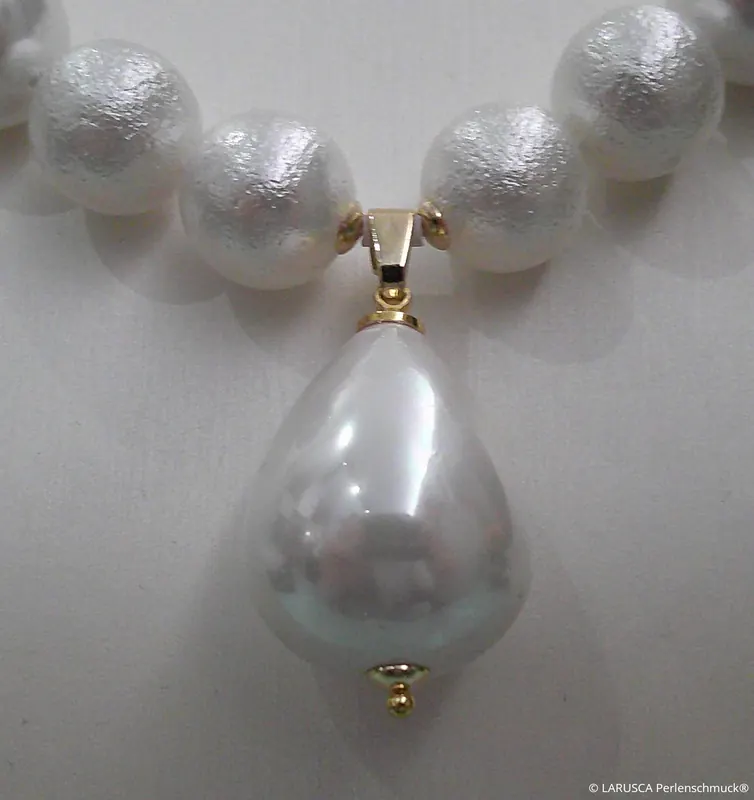
LARUSCA Perlenschmuck® does not use Mallorca pearls to create entire necklaces, but instead incorporates them selectively as individual elements, for example as pendants.