
Edison & Ming Pearls
Discover more about the properties, production and unique characteristics of this material. Learn what makes it distinctive, which quality features are important and how its processing influences its characteristic appearance.
Introduction
Ming/Edison pearls are among the higher-quality Chinese cultured freshwater pearls. They are characterised by their unusual size, strong lustre and often intense natural colours.
Two names, one type of pearl
In international trade, this type of pearl is known as either a Ming pearl or an Edison pearl.
The name Edison was chosen by researchers to emphasise the innovation behind this development in pearl cultivation. It is intended to evoke the revolutionary inventions of Thomas Alva Edison.
The name Ming pearl is also widely used.
The name Ming refers to China’s Ming dynasty, an era still associated today with fine porcelain, the famous Ming vases and a highly developed tradition of craftsmanship.
Innovation and cultivation
In traditional freshwater pearl cultivation, numerous pearls can grow simultaneously within a single mollusc. Their size is limited, however, and perfectly round shapes are also relatively rare.
Pearl growers therefore sought ways to cultivate larger and rounder pearls.
Traditionally, freshwater pearl cultivation involves inserting a small piece of tissue from a donor mollusc into the host mollusc. The host gradually surrounds this piece of tissue with mother-of-pearl.
To cultivate larger pearls, the freshwater mollusc needed to accept a solid core as the basis of the pearl. For a long time, however, this proved unsuccessful.
From the late 1990s onwards, Chinese pearl growers experimented with different species of freshwater molluscs. After many attempts, they succeeded in breeding molluscs that could accept a solid core and surround it with mother-of-pearl. This created the basis for cultivating significantly larger and rounder freshwater pearls.
Colours and shapes
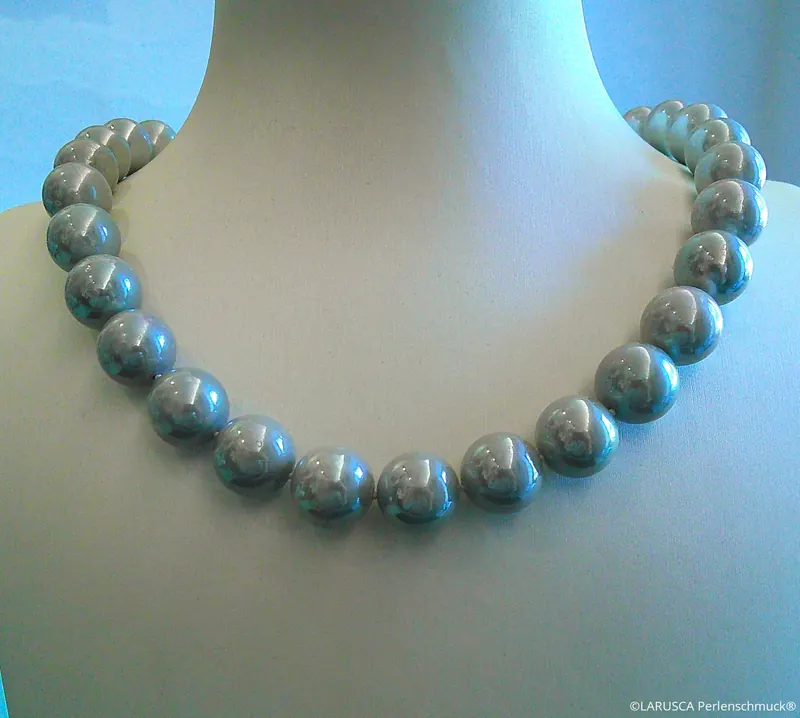
Ming pearls have an intense sheen and can display unusual metallic-looking colours. Typical shades include white, pink, lavender, plum and champagne.
Their shape is usually round or slightly baroque. Ming pearls are also available in gently drop-shaped forms.
At LARUSCA, we use slightly baroque or drop-shaped Ming pearls much more frequently. Their subtly uneven surfaces refract and reflect the light particularly beautifully, creating a lively appearance. We also appreciate these slight irregularities because they show that a pearl is a natural product – and things that grow naturally are rarely perfectly uniform in shape.
Colliers made from carefully selected round Ming pearls can also be created on request.