
Freshwater Pearls – Formation, Cultivation and Characteristics
Each pearl, a small and unique creation of nature.
Main scientific article: Pearls – Formation, Properties and Gemmology
1. Pearls from freshwater habitats
Freshwater pearls form in bivalve molluscs living in rivers, lakes, ponds and other freshwater habitats. A distinction is made between natural freshwater pearls, which form without deliberate human intervention, and freshwater cultured pearls, whose formation is initiated through an intervention in the mollusc.
The term “freshwater pearl” therefore primarily describes the environment in which the pearl originates. It does not identify a single species of mollusc or a particular cultivation method.
While natural freshwater pearls are relatively rare on the market today, freshwater cultured pearls are among the most widely available types of pearls used in jewellery.
China is the leading producer. Japan also has a long history of freshwater pearl cultivation, particularly in Lake Biwa and Lake Kasumigaura.
2. The mussels used in freshwater pearl cultivation
Modern freshwater pearl cultivation mainly uses bivalve molluscs belonging to the family Unionidae. This family comprises numerous species adapted to life in freshwater environments.
One of the most economically important species is the Chinese freshwater mussel Sinohyriopsis cumingii, still referred to in many gemmological publications by its former scientific name, Hyriopsis cumingii.
Another important species is Sinohyriopsis schlegelii, formerly Hyriopsis schlegelii. It originates from Japan and is particularly associated with the Japanese tradition of freshwater pearl cultivation.
Hybrids between these two species have also been developed and used in pearl cultivation. They may combine certain characteristics of their parent species, for example in terms of growth, resilience or pearl-forming capacity.
Historically, Cristaria plicata also played a significant role in Chinese freshwater pearl production.
The mussel species used, its genetic characteristics and the conditions under which it is cultivated all influence pearl development. Numerous biological and environmental factors interact during this process.
Mussels kept under comparable conditions do not necessarily produce pearls of the same size, shape or quality.
3. The biological formation of a cultured pearl
The formation of a cultured pearl is fundamentally based on the same biological processes involved in the formation of a natural pearl.
The decisive factor is the development of a structure known as a pearl sac. This consists of epithelial cells capable of producing nacre and other shell constituents.
In traditional freshwater pearl cultivation, small pieces of mantle tissue from a donor mussel are transplanted into a recipient mussel.
The mantle contains the cells responsible for forming the mussel's shell and its nacreous layer.
Following successful implantation, the transferred epithelial cells can multiply and form an enclosed pearl sac. Cells within this sac subsequently secrete the mineral and organic substances from which the growing pearl is formed.
Nacre consists predominantly of calcium carbonate, usually in the crystalline form aragonite, together with an organic matrix. The interaction of these components produces its characteristic layered structure.
The pearl grows through the continuing deposition of these materials.
The frequently repeated explanation that a mussel merely coats an invading foreign object with nacre therefore provides only an incomplete account of pearl formation.
For deliberate pearl cultivation, the formation of a functioning pearl sac is particularly important.
4. Traditional non-bead freshwater pearl cultivation
In traditional non-bead freshwater pearl cultivation, small pieces of mantle tissue are inserted at suitable sites within the recipient mussel's mantle tissue.
Each tissue graft may develop into an individual pearl sac in which a pearl subsequently grows.
Because no solid spherical bead is inserted, the finished pearl consists essentially of the layers secreted by the cells of the pearl sac. Depending on how it develops, other organic or mineral structures may also be present internally.
A significant feature of this method is the possibility of cultivating several pearls simultaneously within a single mussel.
The number of grafts depends, among other factors, on the mussel species, its size and state of health, and the cultivation technique employed.
Historically, some methods were used to produce several dozen pearls in one mussel. More recent methods that place greater emphasis on quality may use substantially fewer grafts.
Non-bead cultured freshwater pearls can be round, near-round or irregularly shaped. The absence of a solid bead does not necessarily mean that the resulting pearl will have an irregular shape.
5. Cultivation with a solid bead nucleus
Alongside traditional non-bead cultivation, there are also methods in which a solid sphere or a nucleus of another shape is inserted into the mussel.
These nuclei are often made from suitably worked mussel shell material.
In one common method, the nucleus is inserted together with a small piece of suitable mantle tissue.
The epithelial cells develop into a pearl sac that encloses the implanted nucleus and progressively coats it with layers of nacre.
Using a spherical nucleus makes it easier to cultivate large, near-round pearls deliberately. However, it guarantees neither a perfectly round shape nor any particular level of surface quality.
Development continues to depend on pearl-sac formation, the biological conditions during cultivation and meteorological factors.
Methods involving several successive cultivation cycles are also known. In these, existing pearl sacs may be used for further pearl production.
Well-known large bead-nucleated freshwater cultured pearls include those marketed under the names Ming and Edison.
Their historical development, different cultivation techniques and the particular characteristics of these trade names are examined in detail in the dedicated article on Ming and Edison pearls.
6. Regenerated pearls and further cultivation cycles
Under suitable conditions, a freshwater mussel can produce more than one generation of cultured pearls.
The pearl sac already formed plays a decisive role in this process.
If a cultured pearl is removed in a way that allows the mussel to survive and leaves the pearl sac intact, its epithelial cells may continue to secrete pearl-forming materials.
Under appropriate conditions, another pearl may therefore develop within the retained pearl sac.
Another option is to insert a suitable solid bead nucleus into the existing pearl sac after removing the first pearl.
As the sac still contains actively secreting epithelial cells, it can coat the new nucleus with layers of nacre. An additional mantle tissue graft is not necessarily required for such procedures.
Pearls produced by reusing an existing pearl sac are referred to as regenerated pearls (or “Reborn pearls”).
They do not represent a separate biological type of pearl. Rather, they are pearls produced through a particular cultivation procedure or an additional growth cycle.
Regenerated pearls remain cultured pearls even when no new solid nucleus is inserted during a subsequent growth phase.
Successful reuse of a pearl sac depends on the mussel surviving the intervention and the relevant tissue remaining functional. It is therefore not possible after every harvest.
7. Growth and cultivation periods
The growth period of freshwater cultured pearls depends on many factors.
These include, in particular, the mussel species, the cultivation method, water temperature, food availability, water quality and the mussel's health.
Depending on the method, freshwater cultured pearls may develop over approximately one to five years. This range is not a fixed rule.
Large bead-nucleated pearls may require longer growth periods, while other techniques allow shorter production cycles.
Nacre deposition is influenced, among other things, by the mussel's metabolism and environmental conditions.
Changes in these conditions can affect both the rate and the consistency of growth.
At the end of the planned cultivation period, pearls are harvested, cleaned and evaluated according to a range of quality characteristics.
Not every harvested pearl is suitable for use in high-quality jewellery.
8. Shapes and surface structures
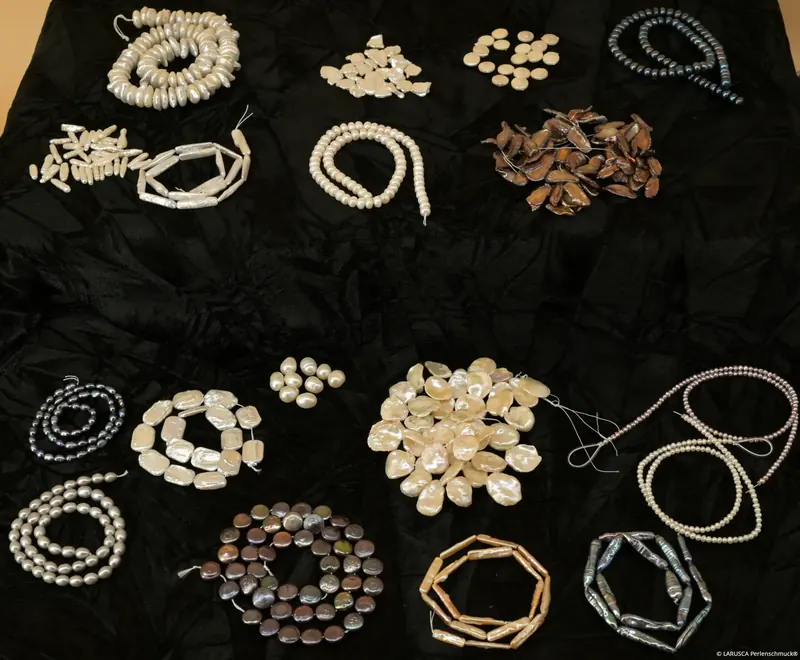
Freshwater cultured pearls display a wide variety of shapes.
Alongside round and near-round pearls, there are oval, drop-shaped, button-shaped and many irregular forms.
Pearls that depart markedly from a spherical shape are often described as baroque pearls.
A pearl's final shape results from the interaction of several factors. These include the cultivation technique, the position and development of the pearl sac, and the deposition of nacre-forming materials.
In bead-nucleated pearls, the shape of the inserted nucleus also influences growth.
Raised areas, depressions, ring-shaped growth structures and other irregularities may develop during pearl formation.
Such surface features arise through biological growth. They can define the appearance of a pearl and may be deliberately sought after in certain jewellery compositions.
Nevertheless, irregularities are not necessarily a defect in quality.
Gemmological assessment distinguishes characteristic shape features from surface blemishes that may adversely affect a pearl's appearance or durability.
A perfectly round pearl is therefore not automatically of higher quality than an irregularly shaped one. Conversely, a strongly textured surface does not prove exceptional quality or demonstrate that a pearl formed naturally rather than through cultivation.
Certain distinctive shapes, including those known as Flameball, Fireball and fishtail pearls, will be examined in a separate article. That article will discuss their formation and the cultivation techniques associated with them.
9. Natural colours and optical properties
Freshwater cultured pearls can display a range of natural colours.
Common tones include white, cream, pink, peach, and various shades of yellow, pinkish violet and lavender.
Colour is influenced, among other factors, by the mussels' genetic characteristics, the tissues involved in pearl growth and the nacreous structures that develop.
Additional colour effects may appear alongside the pearl's bodycolour.
These include subtle overtones and iridescent effects created by the interaction of light with the surface and the internal layered structures.
Lustre is an important quality factor.
It refers to the intensity and sharpness of light reflected at and just beneath the pearl's surface.
Pearls with strong lustre show clear, bright reflections, whereas those with weak lustre may appear rather dull or chalky.
Irregularly shaped pearls can also exhibit exceptionally strong lustre.
A pearl's optical appearance therefore cannot be assessed from its shape or bodycolour alone.
10. Treatments and subsequent colour changes
Not every colour or surface appearance found among freshwater pearls on the market today results exclusively from natural growth processes.
After harvesting, pearls may undergo various treatments.
Common procedures include bleaching and dyeing.
Bleaching may be used to reduce unwanted discolouration or to produce a more uniform appearance.
Dyeing makes it possible to alter existing shades or create additional colours.
Particularly dark or intense colours may suggest a treatment. However, visible colour alone does not always allow a reliable distinction between natural and treated colouration.
Treatment after harvesting does not alter the biological origin of a cultured pearl.
It remains a product formed by a mollusc and must be distinguished from an artificial pearl imitation.
For an accurate description, however, it is important to disclose whether a pearl developed its colour naturally or whether that colour was subsequently altered.
11. Freshwater pearl cultivation and the environment
Freshwater mussels are filter-feeding organisms. They draw in water and remove, among other things, plankton and fine suspended organic particles.
They therefore perform important functions within aquatic ecosystems.
Many species are sensitive to changes in water quality, oxygen levels and nutrient balance.
Suitable environmental conditions are also crucial to pearl cultivation, as weakened or unhealthy mussels are less likely to provide consistently favourable conditions for growth.
Under appropriate circumstances, responsibly managed mussel cultivation can contribute to improvements in water quality.
A positive environmental effect cannot, however, be assumed in every case.
In the past, excessive stocking densities and unsuitable management practices caused substantial pressures on water bodies in certain Chinese pearl-producing regions, particularly through excessive nutrient inputs.
Stricter environmental regulations have therefore been introduced in recent years, while various production methods have been further developed.
Alongside monitoring water quality, adjusting stocking densities and moving towards quality-focused cultivation are becoming increasingly important.
Any ecological assessment of freshwater pearl production must therefore take account of the actual conditions at the individual cultivation facility.
12. Natural river pearls and their historical significance
The terms “freshwater pearl” and “river pearl” are sometimes used interchangeably in everyday language.
Strictly speaking, a freshwater pearl is a pearl formed in a mollusc living in freshwater. The term therefore encompasses pearls from rivers as well as those from lakes and ponds.
The expression “river pearl”, by contrast, is often associated with natural pearls found in flowing waters. On its own, however, it does not establish that a pearl formed naturally, without deliberate cultivation.
Natural pearls from the European freshwater pearl mussel, Margaritifera margaritifera, are of particular historical significance.
For centuries, this species was deliberately collected to obtain pearls.
Because its populations have declined sharply and are now subject to legal protection, historical pearl fishing is no longer permitted in many regions.
Nevertheless, natural river pearls can still be found in antique jewellery, collectors' items and, occasionally, on the specialist market.
The history of natural river pearls, their biological characteristics and their present-day trading situation will be covered in a separate scientific article.
13. The diversity of freshwater pearls
Modern freshwater pearl cultivation encompasses different mussel species, cultivation methods and patterns of growth.
From small non-bead cultured pearls to large bead-nucleated examples, the range includes pearls that vary considerably in shape, colour, surface characteristics and optical appearance.
Some names describe geographical origin, while others refer to specific cultivation methods, characteristic shapes or commercial product categories.
Biwa and Kasumi pearls, for example, are closely associated with particular Japanese lakes and their pearl-cultivation traditions. Ming and Edison, on the other hand, are primarily trade names used for certain types of large freshwater cultured pearls.
Understanding these distinctions allows pearls offered on the market to be classified more accurately.
Detailed examinations of individual pearl types, their origins and their particular production methods therefore complement this general overview.
Further reading and pearl jewellery
- Ming and Edison pearls – origin, cultivation and characteristics: a more detailed examination of large bead-nucleated freshwater cultured pearls.
- Pearls – Formation, Properties and Gemmology: return to the main scientific overview of pearls.
- Freshwater pearl necklaces in the LARUSCA shop: jewellery compositions featuring freshwater pearls.
- LARUSCA shop overview: all jewellery categories at a glance.
Sources and further scientific literature
The following sources provide the basis for the biological, gemmological, historical and environmental information presented here. The chapter references indicate the main topics supported by each source.
- CIBJO (2024): The Pearl Book. World Jewellery Confederation, Pearl Commission. Specialist terminology, distinctions between natural and cultured pearls, origin and treatments. Chapters 1, 3, 5, 10 and 12. CIBJO Pearl Book (PDF).
- Fiske, D.; Shepherd, J. (2007): Continuity and Change in Chinese Freshwater Pearl Culture. Gems & Gemology, 43(2), 138–145. Mussel species, tissue grafting, bead nucleation and historical development. Chapters 1–5 and 13. GIA article.
- Zhou, Q. et al. (2026): Policy-Driven Sustainability in China’s Freshwater Pearl Culturing Industry. Gems & Gemology, Summer 2026. Cultivation methods, multi-stage pearl production, regeneration and environmental conditions. Chapters 1, 4–7 and 11. GIA article.
- ITIS – Integrated Taxonomic Information System: Zoological classification and synonyms for Sinohyriopsis cumingii and Sinohyriopsis schlegelii. Chapter 2. S. cumingii · S. schlegelii.
- GIA – Gemological Institute of America: Pearl Quality Factors. Quality characteristics including shape, colour, lustre, surface, nacre and matching. Chapters 8 and 9. GIA overview.
- Zhou, C. et al. (2021): Detection of Color Treatment and Optical Brightening in Chinese Freshwater “Edison” Pearls. Gems & Gemology, 57(2). An investigation into natural and treated colours, as well as subsequent optical brightening. Chapters 9 and 10. GIA article.
- NatureScot: Freshwater pearl mussel and Freshwater pearl mussels and licensing. Ecology, historical pearl fishing, threats and protection of Margaritifera margaritifera. Chapters 11 and 12. Species profile · Protection and licensing.