South Sea shell-nucleus pearls
Discover more about the properties, production and unique characteristics of this material. Learn what makes it distinctive, which quality features are important and how its processing influences its characteristic appearance.
Introduction
Shell pearls are often unfairly dismissed as cheap imitation pearls.
South Sea shell pearls, however, are a modern, high-quality and environmentally friendly alternative to cultured pearls. They are a distinct type of pearl in their own right and are becoming increasingly popular in jewellery making.
This knowledge chapter explores the fascinating subject of shell pearls in greater detail.
Production
Yes, you read that correctly: shell pearls are manufactured. They do not grow inside a living mollusc but are made by people using a complex process.
The core is shaped from the shell of a mollusc that has been discarded during pearl cultivation. It therefore consists of genuine, natural shell material.
It is good to know that a discarded shell is given a second «life» rather than simply being thrown away. Shell pearls combine beauty with sustainability.
In an elaborate process, the core is coated with numerous layers of mother-of-pearl.
The mixture applied to the core consists of finely ground mother-of-pearl and composite.
Composite is a high-quality, extremely durable, ceramic-like synthetic resin that is cured using UV light. In dentistry, composite is used, for example, to reconstruct a chipped tooth.
Colour pigments can also be added to the mixture, making virtually any colour variation possible.
The use of natural mother-of-pearl and the application of multiple layers create a particularly deep and refined sheen, with a lustre comparable to that of a cultured pearl.
Characteristics
As described above, a shell pearl consists largely of natural mother-of-pearl. Its characteristics are therefore very similar to those of a cultured pearl.
Shell pearls are somewhat more forgiving than cultured pearls, which makes them particularly suitable for more frequent everyday wear.
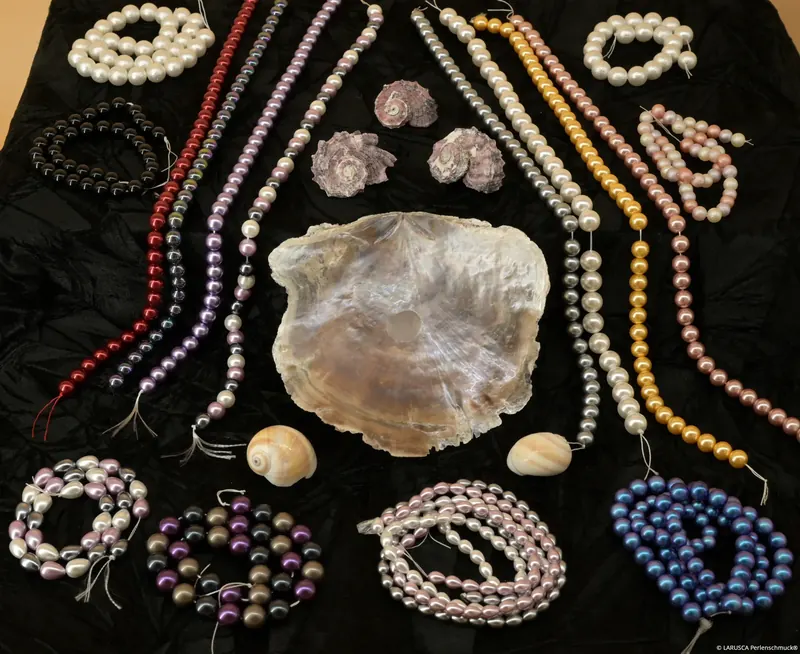
Shell pearls are available in many different sizes. Most are perfectly round, but they are also available in drop shapes, coin shapes and, more recently, in baroque forms.
Their deep sheen and intense lustre are comparable to those of cultured pearls. With an almost unlimited choice of colours, they are highly versatile and can be combined in countless ways.
Surface finishing
Shell pearls most commonly have a high-gloss surface. More recently, however, «frosted» and matt shell pearls have also become available.
Electroplating
This finishing process gives shell pearls a high-quality surface with a metallic sheen. Its appearance can seem almost cool and can complement a pearl composition particularly well.
Electroplating is an electrochemical process. The shell pearl is first treated with an electrically conductive protective coating. In a second step, an extremely thin layer of copper is usually applied to the pearl to further improve the adhesion of the subsequent metal layer. The final electroplating bath deposits the fine, decorative metal layer that will remain visible. This layer can also be lightly coloured, creating beautiful colour contrasts on the shell pearl.
«Frosted» surface
This surface texture resembles the surface of a snowball.
The shell pearl is subsequently and carefully etched. Minerals of different grain sizes are added to the acidic medium. Depending on the duration of the etching process, irregularities of varying depth are created.
Light is refracted and reflected by the uneven surface, producing a particularly attractive effect.
Matt surface
As with the «frosted» finish, the matt surface is also produced by etching, but without the addition of mineral particles.
The matt finish is very even and fine, giving the pearl a soft, velvety surface texture.
Distinction from imitation pearls
Shell pearls are a high-quality type of pearl made from natural materials and are frequently imitated.
These imitations are often made from glass that is coated or painted.
Plastic pearls, known as ABS pearls, are also widely available. Inexpensive costume jewellery is often made from such imitation pearls.
LARUSCA Perlenschmuck® never uses these inexpensive imitations.
The difference between shell pearls and Mallorca pearls
As described above, shell pearls are made using genuine mother-of-pearl.
Mallorca pearls, by contrast, are treated, among other things, with an essence derived from fish scales. Although this produces a slight iridescent shimmer, it cannot equal genuine mother-of-pearl.
You can find more detailed information about their production in our knowledge chapter on Mallorca pearls.
Other names
In international trade, South Sea shell pearls are also commonly referred to as Shell Pearls.